HEAR "STRENGTH STARTS AT THE CORE" OUT OF CONTEXT AND YOU'D PROBABLY PICTURE A GYM POSTER. CRUNCHES, PROTEIN SHAKES, SOMEONE YELLING ENCOURAGEMENT. FAIR ENOUGH. IT'S NOT WHAT WE MEAN, THOUGH, AND FOR A RESEARCH PEPTIDE BRAND THAT DIFFERENCE MATTERS MORE THAN YOU'D THINK.
For us, the core isn't a body. It's the boring, load-bearing stuff underneath a company: the product names, the lab reports, the support inbox, the checkout page. If those hold, everything built on top of them holds too. If they wobble, no amount of marketing will keep the thing standing.
When Jeffrey Dupaul and Zachary Festa picked that line for Titan Core, they picked it as a working standard, not a mood. Here's what it looks like in practice, piece by piece.
Getting the name right, every single time
It sounds too basic to mention. It isn't. Peptide catalogs are full of near-lookalikes: similar names, similar vials, sometimes a single letter apart. One sloppy label or a product page linked to the wrong report, and the buyer ends up holding something that doesn't match anything they can check.
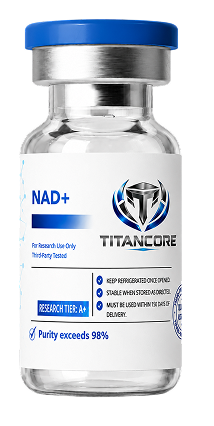
So the first layer of the core is plain discipline. One official emblem. One cobalt-blue cap. One naming system that runs the same way across the vial, the product page and the report that goes with it. Consistency makes a brand easier to remember, sure. The bigger payoff is fewer mix-ups, and in this business, mix-ups are the expensive kind of mistake.
HPLC vs mass spectrometry: two tests, two different questions
Here's where a lot of sellers blur things, sometimes on purpose. They'll show you a purity number and let you assume it means more than it does.
Take Semax and Selank. Both are short, seven-amino-acid peptides. Both even end in the same three residues, Pro-Gly-Pro. On an HPLC trace, each one can come back looking beautifully clean. And that's the catch: HPLC tells you how pure a sample is. It doesn't tell you which peptide it is.
Mass spectrometry answers that second question. Intact Semax weighs about 813.9 daltons, and Selank weighs about 751.9. Put a sample through a mass spec and the number tells you which molecule you've actually got. That's why our Semax page lists both checks side by side, purity by HPLC and identity by mass, instead of letting one stand in for the other.
It's also why we try to keep every claim inside the edges of its evidence. A peptide purity result is a purity result. It isn't proof of identity, it isn't a sterility test, and it definitely isn't a statement about safety or suitability for anything outside a lab. Everything we sell is for laboratory research only, and we'd rather tell you exactly what a test shows than let a nice number do the talking. Our quality standards page walks through how that testing fits together.
The support inbox is part of the product
Most companies treat support as a link in the footer. Buyers don't.
Zendesk's CX Trends research, based on a survey of nearly 3,700 customers across 20 countries, found that more than half of customers will walk away after a single bad support interaction, and 73% will switch after several. That lines up with what we see in this market. People rarely leave over one late package. They leave over the email that never got answered, or the answer that didn't match their question.
A support path worth having should let you ask which report goes with which LOT, check whether something is in stock without trusting a stale page, get clear answers about our research-only terms, and sort out an order problem. And when we don't know something yet, you should hear that too. "We're checking and we'll come back to you" beats a confident guess every time.
How a research peptide brand should grow
This one's more about how we run the company, but it affects you directly.
It's tempting for a new brand to chase traffic first and fix things later. We think that's backwards. Baymard Institute's checkout research, updated in 2025, found that 19% of shoppers who abandon an order do it because they don't trust the site with their card details, and 17% leave because the site threw errors or crashed. Send more people into a broken journey and you haven't grown anything. You've just shown more people the cracks.
So the order goes like this at Titan Core. Get the product and company information right. Make sure the pages, checkout and support actually work. Tie every quality statement to real evidence. Then publish useful material and see who comes back. Only after that do we scale up. If you're going to buy research peptides online from a young company, that's the order you should want it to follow.
The Core Check
Before a page, a product update or a campaign goes live, our team runs through a short list:
- Is the product identity correct, down to the name and the LOT?
- Does every link on the page actually go where it says?
- Does the evidence support the claim for this specific batch?
- Is the research-only message clear from the page as a whole, not only in the fine print?
- Is the next step for the buyer useful and truthful?
- Is someone clearly responsible for answering questions and keeping the page current?
If any answer is no, the page waits. Fixing the foundation first is slower, and it's supposed to be. That's the whole meaning of Strength Starts at the Core, and it's the standard Jeffrey and Zachary put their names behind.
Sources and further reading
- Zendesk CX Trends Report 2023 (January 2023)
- Baymard Institute: Cart Abandonment Rate Statistics (updated 2025)
- PubChem: Semax, C₃₇H₅₁N₉O₁₀S
- PubChem: Selank, C₃₃H₅₇N₁₁O₉
For research and laboratory context only. This article makes no medical, therapeutic, performance or human-use claim.
Research-use notice: All Titan Core products are sold strictly for laboratory research use and are not for human consumption. Check the product page, its LOT and its current documentation before placing an order.